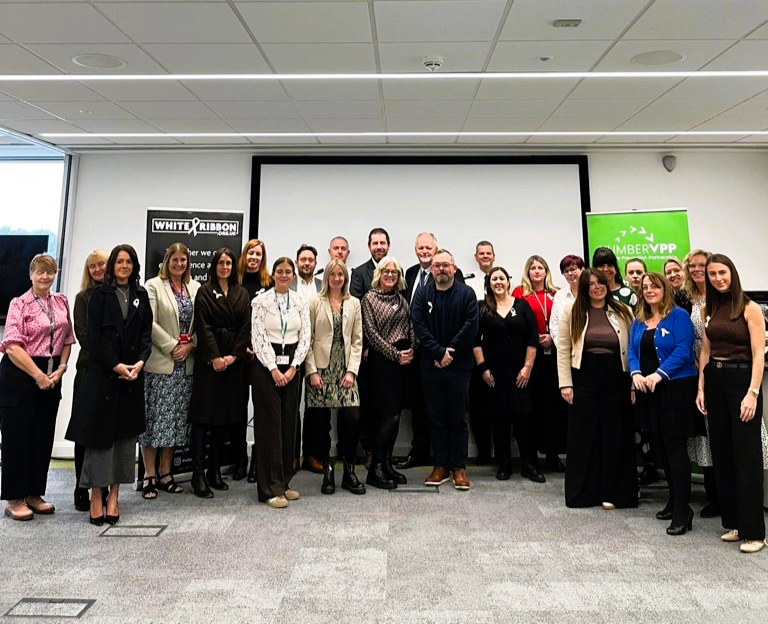
Our Youth Connect project brings together reports, surveys and engagement findings from across the region, making it easier to understand what local young people are saying about perceptions of safety and violence.
As part of White Ribbon’s 16 Days of Action, we’re sharing the below insights into what young people in Humberside are telling us about violence against women and girls (VAWG). You can view the sources for this blog by clicking here.
Looking for free and trusted advice, services and resources focused on preventing VAWG? Click here to visit our Useful Resources page.
Which community spaces feel unsafe for women and girls?
Girls frequently experience everyday intimidation in public, reporting being cat-called, whistled at, intrusively stared at, and followed. Some shared more extreme accounts of being chased by adults.
Young women report feeling significantly less safe on public transport (including buses and trains) than young men during both the day and after dark. Bus stations and train platforms are specifically highlighted as areas of extreme discomfort if groups of other young people are hanging around or if fighting is witnessed.
While girls feel fairly safe in parks, town centres and open spaces during daylight, they identify them as major sources of anxiety and locations to avoid after dark. Environmental factors such as poor street lighting, run-down buildings, graffiti and litter significantly increase feelings of vulnerability and the perception of crime.
The presence of "loud crowds" or groups of people under the influence of drugs or alcohol makes young women feel vulnerable. To counter this, they often rely on "safety in numbers" and feel more secure in mixed-gendered social groups.
Because of these concerns, young women are statistically more likely than boys to take active safety steps, such as staying in well-lit areas, arranging for a lift, or speaking on the phone while walking to act as a deterrent.
Relationship violence
Young women show a high level of awareness regarding domestic abuse and unhealthy relationship dynamics.
Girls are statistically more likely than boys to recognise coercive control and sexual pressure as forms of abuse. For instance, 87% of girls identified pressuring someone into sex or touching without consent as domestic abuse, compared to 78% of boys.
There is a significant concern regarding "sexting" and online harassment. Girls are much more likely than boys to both receive and be asked to send sexual messages or images, and they are more likely to take active steps to block such contact.
The need for female-only safe spaces
Young women have stated they would be more likely to attend youth sessions (particularly for sports or creative activities like hair and beauty) if they were female-only.
A recurring theme is the desire for spaces where girls can feel free from harassment and judgment. In sports and school settings, girls often feel judged and embarrassed regarding their physical abilities or body image, which acts as a barrier to participation.
Girls have expressed that a lack of empathy from male coaches and teachers regarding issues specifically affecting them – such as period poverty or sexual harassment – makes them anxious about approaching these adults for help.
Masculinity and respect
Young men report feeling heavy pressure to conform to traditional standards of strength, which directly impacts how they view respect and emotional boundaries.
Boys frequently cite a societal push to be "strong," "not emotional” and to "man up." This mindset leads many to hide their feelings or pretend everything is fine even when they are struggling. Interaction with friends is often defined by "banter," jokes, and "messing about," but many boys explicitly note that they interact with their peers "with respect."
Many young men feel a lack of respect from authorities. They report feeling targeted or stopped due to negative stereotypes about "youths" or their specific neighbourhoods.
Turning youth voice into action
Want to further explore what young people across Humberside are saying about safety and violence? Use Youth Connect to discover evidence-based insights and help turn youth voice into action.